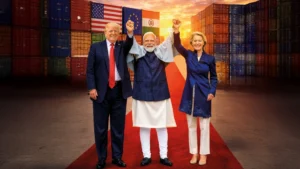

New Delhi: “There are decades where nothing happens; and there are weeks where decades happen.” This famous remark by Vladimir Lenin aptly captures the pace of recent economic developments in India. The period between January 26 and February 2 has marked a decisive shift in the country’s trade and economic trajectory, with policymakers addressing long-standing challenges in a remarkably short span.
The week began with a significant breakthrough in trade negotiations between India and the 27-member European Union, paving the way for a long-awaited Free Trade Agreement (FTA). This was followed by the presentation of the Union Budget 2026–27 on February 1, which placed strong emphasis on growth, infrastructure, and capacity building.
Adding to the momentum, a late-night announcement on February 2 by Donald Trump revealed a new trade pact between India and the United States. The agreement is expected to significantly reduce tariffs on select Indian goods, bringing them down from as high as 50% to 18%, thereby enhancing the competitiveness of Indian exports in global markets.
Together, these three developments—the India-EU FTA, a growth-oriented Union Budget, and the India-US trade agreement—signal a comprehensive reset in India’s global trade engagement. Economists and industry experts believe these measures could substantially improve India’s economic outlook for FY27 by reducing uncertainty and encouraging fresh investments.
While the full impact will depend on the finer details and effective implementation of these policies, there is growing optimism among policymakers and businesses that these initiatives will stimulate economic activity, strengthen international partnerships, and position India as a more dynamic player in the global economy.
News Ref. & Credit : https://www.businesstoday.in/magazine/cover-story/story/how-india-has-orchestrated-a-reset-in-its-trade-ties-516160-2026-02-15